Dan McGuire: A Mizzou Rugby Original
When Daniel John "Dan" McGuire — "Mac" to his teammates — first took the field for Mizzou Rugby in the spring of 1967, there was no long tradition to inherit. There were no Western Championships, no collegiate national playoffs and no sevens program. Mizzou Rugby itself had only recently been created. McGuire was part of the generation that had to learn the game, build the club and establish the traditions that future Tigers would inherit. He played for Missouri from the spring of 1967 through the spring of 1969, primarily at prop and second row, and became part of one of the defining periods in the earliest history of the club.
Those first Mizzou teams were learning a sport that was still relatively unfamiliar on American college campuses, and they were fortunate to have coaches who brought rugby knowledge from some of the places where the game was deeply established. Club co-founder Warren Sutton, from Auckland, New Zealand, helped lead the Tigers in 1966-67. From 1967 through 1969, Bill Jenkins of Pretoria, South Africa, and Iain Christison of Glasgow, Scotland, continued developing the young club. Their international backgrounds gave McGuire and his teammates an education in the game that would help transform a new organization into a competitive rugby side.
By the fall of 1968, that education was paying off. All three Mizzou sides went undefeated that fall, an extraordinary accomplishment for a club only a few years old. That same season produced another milestone when Missouri became champion of the inaugural Heart of America Tournament in Kansas City. McGuire captained the Second Side that won the tournament championship, while Mizzou's First Side defeated the University of Kansas in an exhibition match. For a young club still establishing itself, it was an early indication that Missouri Rugby could compete with the best teams in the region.
Competition in those years was decidedly regional, and there were already rivalries beginning to form. McGuire remembers Kansas City Rugby Club, the Kansas City Blues and the University of Kansas as some of Mizzou's toughest opponents. Rolla School of Mines, as Missouri S&T was then known, was another regular adversary. These were the teams against which an emerging Mizzou program began measuring itself and establishing its reputation.
The Tigers also traveled extensively for a club that was still in its infancy. McGuire played in the 1967 St. Louis Easter Ruggerfest and the 1967 and 1968 Midwest Tournaments in Chicago. In 1968, the team traveled south for the New Orleans Mardi Gras Tournament before capturing the inaugural Heart of America title later that year. Then, in 1969, Mizzou traveled all the way to Washington, D.C., for the Third Annual Cherry Blossom Tournament, where the Tigers finished sixth.
That Cherry Blossom Tournament remains one of McGuire's strongest memories from his Mizzou years. The matches were played on the South White House Ellipse, placing a group of college rugby players literally next to the White House and in the shadow of the Washington Monument. For a young player during the formative years of American rugby, it was an unforgettable setting. McGuire also remembers captaining the Second Side to the first Heart of America championship and, with a smile, "all the fun we had at the Mardi Gras Tournament in the Big Easy."
After playing at Mizzou and two years in the Army — almost all young men served in those years — McGuire joined the St. Louis Ramblers in 1971 and stayed nine seasons, proudly wearing the green and white of one of the oldest rugby clubs in the United States, founded in 1933. He served the Ramblers in turn as Match Secretary, Coach and President.
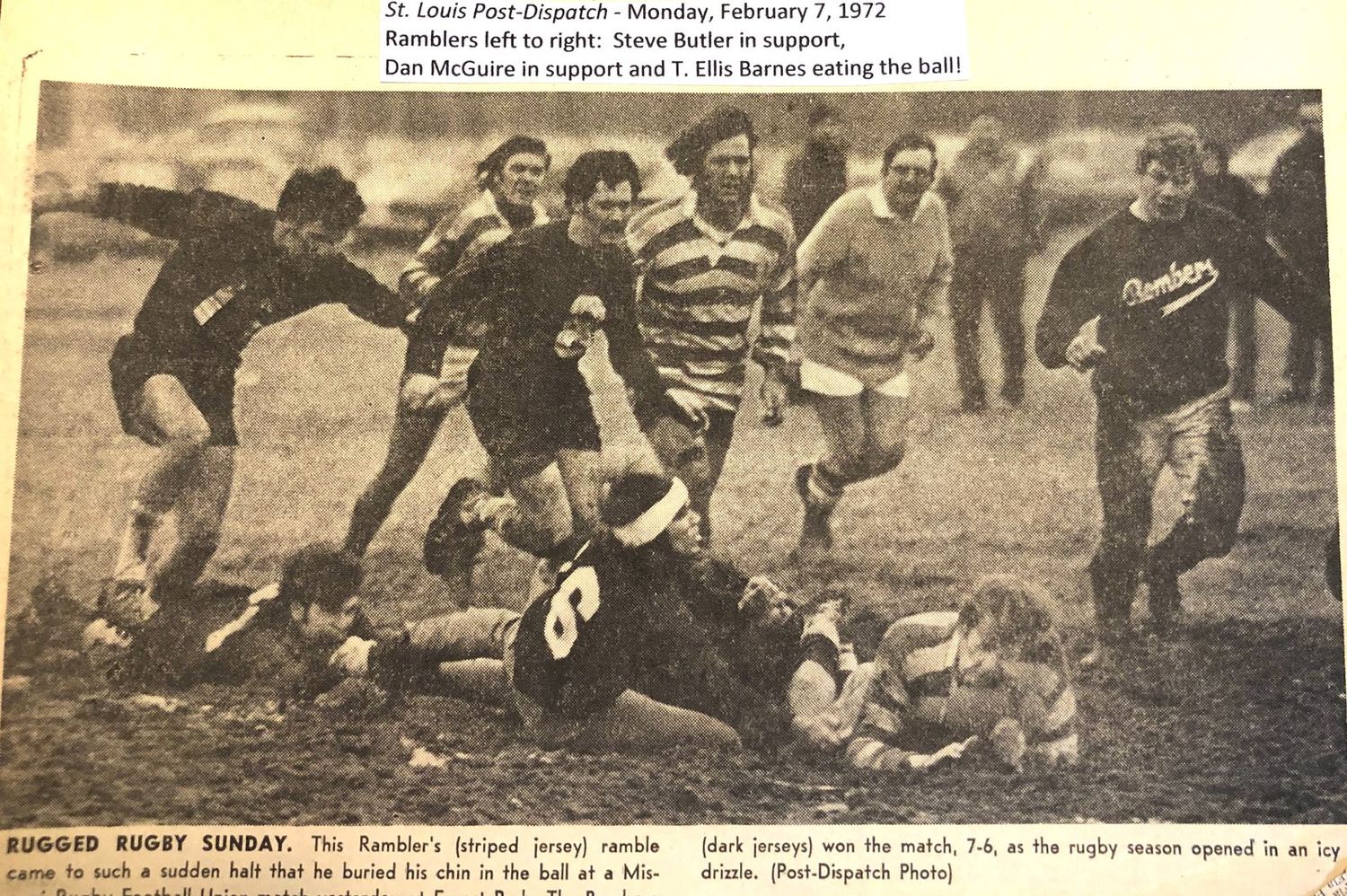
He also began pulling the club outward. In 1973 he scheduled and played in the Ramblers' matches against the touring Cirencester RFC of England — the first European club ever to tour in the Missouri Rugby Football Union. That same year he led a party of nine Ramblers and other Missouri union players abroad under the colors of the Mill Creek Valley Athletic Union, the first MRFU side ever to tour Europe, playing clubs in England, France, Belgium and the Netherlands.
Then he took up the whistle. McGuire served as a Director, Head Referee and President of the Missouri Rugby Football Union, and refereed at a higher level for the Western Rugby Football Union, whose territory ran from the Rockies down to Texas. He had a reputation for keeping order in matches that badly needed it. During the MRFU's 50th anniversary weekend in 1983, in front of national and international rugby dignitaries including J.V. Smith, President of England's Rugby Football Union, McGuire refereed the Ramblers — celebrating their own 50th — against Girling Brakes RFC of Wales. Smith later wrote about the St. Louis trip and the match in his 1985 book, Good Morning President: Rugby From The Top.
He was an early and practical supporter of women's rugby. In 1973 he helped coach the “Pink Ramblers” as his wife, Jill, and her teammates prepared to face the North St. Louis Women in the first women's rugby match ever played in the MRFU, at the annual Easter Ruggerfest in Forest Park. That match was the spark for the St. Louis Women's RFC, which survives today as the St. Louis Sabres. McGuire went on refereeing women's matches through the 1970s and into the early 1980s.
Some of his most durable contributions to the game were made in a city council chamber rather than on a pitch. As Alderman for the 28th Ward in St. Louis, McGuire sponsored City Ordinance 58827 in 1983, naming the Forest Park field beside the Dwight Davis Tennis Center in honor of H.F. “Harry” Langenberg — a founder of both the MRFU and the Rambler club in 1933, and an officer and player in both for fifty years. That pitch hosted rugby for decades. In the mid-1990s, McGuire made sure three dedicated rugby pitches on Central Field were written into the 1995 Forest Park Master Plan, and later built. Ruggers are still playing on them. He also served the city as its Parks Director.
McGuire is a proud rugby dad, too: his son John McGuire is also a Mizzou Rugby Club alumnus. And he has never really left the club himself. A player from 1967 to 1969, he has been a supporter of Mizzou Rugby every year since, and still makes his home in St. Louis.
John puts his father's rugby life another way. When Dan discovered the game at Mizzou in the 1960s, rugby in America was very much a counter-culture sport — a chance to be wild, live by one's own rules, test one's mettle in competition and celebrate it all afterwards — but one grounded, quietly and unmistakably, in respect, camaraderie, tradition and duty. His father embraced all of that with what John calls a pure esprit de jouer, and has lived it since "with integrity, honor, humility, humor and candor," passing on to his son and to generations of other players the pull of a purpose-driven life through rugby, and dedicated service to community, club and family — "all with a healthy boyish dedication to mischievous, lighthearted fun." If rugby is, as the old line has it, a game for barbarians played by gentlemen, John's summary of his father is short: "Dan McGuire, a Mizzou Rugby Gentleman."
Ask McGuire for the funniest stories from those road trips, however, and nearly six decades of discretion suddenly takes over. His answer to the alumni questionnaire was simple: "I think I better keep those to myself." He added an explanation that generations of ruggers will understand: "There is no family Statute of Limitations on our past shenanigans."
Behind the humor is something much more significant. When McGuire was asked to identify his favorite Mizzou Rugby memory, he didn't name a championship, a great individual performance or even one of those remarkable trips. His answer was simply, "Just learning the Game." The reason explains the significance of Mizzou Rugby in his life: "It set the focus of my life for the next 20 years."
That statement captures what made the earliest years of Mizzou Rugby so important. McGuire and his teammates weren't merely joining an established college sports program. They were discovering rugby together and building something that did not previously exist at Missouri. The lessons taught by Sutton, Jenkins and Christison were carried onto fields across the Midwest and eventually passed to the generations of Tigers who followed — among them the dictum of player-coach Iain Christison that McGuire has quoted for nearly sixty years: the game is always greater than the score. The undefeated sides of 1968, the inaugural Heart of America championship and trips to Chicago, New Orleans and Washington became some of the first chapters in what would grow into a decades-long Mizzou Rugby tradition.
McGuire has also worked to make sure that history isn't lost. Years later, he documented the origins of the club in his 2011 article, Missouri University Rugby Club: The First Years, Fall 1966 – Spring 1969. He preserved and shared original club rosters from the 1966-67, 1967-68 and 1968-69 seasons, along with official team photographs and other materials from those formative years. Those records provide an important connection between today's Mizzou Rugby community and the young men who first began building the club nearly 60 years ago.
With that history also comes remembrance. McGuire has watched a number of the men from those early rugby years pass away. He remembers club co-founder and fellow St. Louis Rambler Chip Maxwell, along with Charlie Stecher, Bill Bates, Ed Lampitt, Lance Friesz, Stan Feldman and Keith Eickenhorst. He also remembers Larry Petersen, who played at Mizzou after McGuire's own playing years and became lifelong friends and St. Louis Rambler Rugby Club teammates with Charlie, Ike and Dan.
Looking back, Dan McGuire's Mizzou Rugby story is important not simply because of what he accomplished, but because of when he accomplished it. He was there when the traditions were still being invented. He was there when Mizzou Rugby was learning how to play, whom to play and just how good it could become. He helped captain a championship side, played during an undefeated season, competed against some of the region's earliest rugby powers and carried the Missouri colors from Kansas City and Chicago to New Orleans and Washington, D.C.
Every rugby club eventually reaches an age when its newest players can take its existence for granted. There are schedules, alumni, rivalries, trophies, traditions and stories waiting for them when they arrive. But none of those things exist without an original generation willing to build them.
Dan McGuire was part of that generation.
And when asked what mattered most about those years, his answer remains remarkably simple: learning the game changed the direction of his life for the next 20 years. In the process, McGuire and his teammates helped give generations of Missouri Tigers the opportunity to learn that same game and make it part of their lives as well.